
How to Check Your Barn, Garage, and Foundation for Mice After Harvest
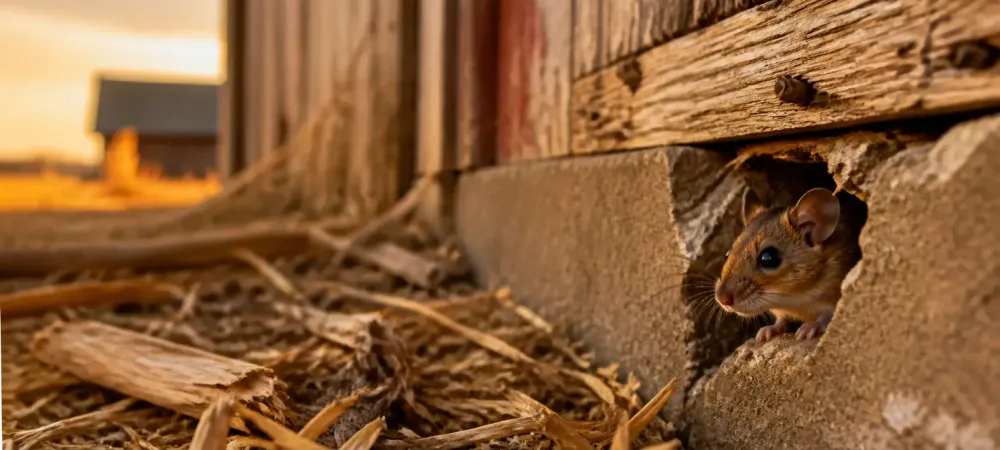
Mice move toward barns, garages, and houses across Frederick County in the fall because harvest and mowing strip away the cover and food they relied on all summer, right as nights turn cold. A quick inspection of each building, focused on the gaps a mouse can actually use, tells you where you stand before mice settle in for the winter.
Hay, apples, corn, soybeans, and wheat dominate Frederick County farmland, and when those fields are cut and orchards are picked, field mice lose the tall cover and dropped food that hid and fed them. Virginia Cooperative Extension lists forage, apples, corn for grain, soybeans, and wheat as the county's top crops by acreage across 762 farms in the 2017 Census of Agriculture.
Many Frederick County homes sit right next to that farmland. The county's comprehensive plan notes that rural residential development is concentrated in the limestone belt west of Winchester, Interstate 81, and Route 37. For those properties, the barn and garage are usually the first stop for mice, and the house is next.
Cold is the second push. A barn with stored feed, hay, and equipment offers warmth, food, and nesting material in one place, so outbuildings tend to show activity before the house does.
A mouse can fit through a hole the width of a pencil, about 1/4 inch, according to the Centers for Disease Control and Prevention. Most mouse entry points are gaps you would walk past without noticing, such as a worn door sweep, a pipe penetration, or a crack where siding meets the foundation.
The CDC recommends checking between the foundation and the ground, around doors and windows without weather stripping, around attic and crawl space vents, and around every electrical, plumbing, cable, and gas line. The CDC also specifically calls for sealing outbuildings and garages, not just the house.
In older homes with stone or block foundations, mice most often get in through deteriorated mortar joints, settling cracks, and gaps around pipes and wiring that were added long after the house was built.
Newer poured foundations have fewer joints, so mouse entry on a newer home usually happens higher up, at the sill plate, garage door corners, and utility openings. An older stone foundation can have dozens of small voids, which is why sealing an older property takes longer than a quick walk-around suggests.
| Structure | Common Entry Points | What to Look For |
|---|---|---|
| Barn or outbuilding | Gaps under doors, open eaves, loose or rotted siding boards | Chewed feed bags, droppings along walls, nests in stored hay or equipment |
| Detached garage | Worn bottom door seal, door corners, utility penetrations | Droppings near stored birdseed, pet food, or grass seed, and nests in boxes or idle vehicles |
| Older stone or block foundation | Deteriorated mortar joints, settling cracks, old pipe openings | Droppings in the basement and dark rub marks along walls |
| Newer home | Sill plate gaps, dryer vents, AC line openings, garage-to-house door | Droppings under sinks and behind appliances, and scratching in walls at night |
Work from the outbuildings toward the house, since mice usually concentrate where feed and stored materials are, then move closer as the weather turns.
- 1Start with the building that stores feed or seed. Check barns and sheds for droppings, gnawed feed bags, and nesting material along walls and in corners. Store grain and animal feed in thick plastic or metal containers with tight lids, as the CDC recommends.
- 2Check garage door seals and corners. Look at the bottom seal and both lower corners of every garage door. Daylight or a gap wider than a pencil is an open door for mice.
- 3Walk the foundation at ground level. Follow the line where the foundation meets the soil or siding, and note cracks, crumbling mortar, and gaps around hose bibs, dryer vents, and utility lines.
- 4Match inside signs to outside gaps. In the basement or crawl space, check around pipes, floor drains, and the joint where the floor meets the wall, then compare what you find to the gaps you spotted outside.
- 5Seal small gaps with steel wool and caulk. The CDC recommends packing small holes with steel wool held in place with caulk or spray foam, and using hardware cloth, metal sheeting, or cement for larger openings.
- 6Pull woodpiles and brush away from the house. The CDC advises keeping woodpiles 100 feet or more from the home and raised at least one foot off the ground, and keeping brush and grass near the house trimmed.
- 7Clean up droppings without sweeping. Air out closed buildings for 30 minutes, then spray droppings with a disinfectant or bleach solution, let it soak for 5 minutes, and wipe it up with paper towels. The CDC warns that sweeping or vacuuming droppings can put virus particles in the air.
No reliable evidence shows ultrasonic devices keep mice away. The Federal Trade Commission warned more than 60 manufacturers and retailers in 2001 that their efficacy claims needed scientific support, and earlier FTC complaints alleged that rodents get used to the sound and return to their nesting and feeding areas.
A barn full of stored feed will keep attracting mice no matter what is plugged into the wall. Sealing entry points, removing food and nesting sources, and trapping are what reduce a mouse population.
Droppings in several buildings, gnawed wiring, or activity inside the walls of the house mean the mouse population is established, and sealing alone will not catch up.
On larger rural properties, the challenge is usually the number of entry points, not any single fix. Our rodent control team in Winchester can inspect the barn, garage, and house together so nothing gets missed. If the droppings are bigger than a mouse's or something is denning under the barn, our wildlife removal service handles larger animals.
Mice move into buildings in the fall as temperatures drop and harvest removes the field cover and food they used all summer. Barns and garages near cropland are usually hit first.
The CDC says a mouse can fit through a hole about 1/4 inch wide, roughly the width of a pencil.
No. The CDC advises against sweeping or vacuuming rodent droppings because it can put virus particles in the air. Spray droppings with a disinfectant, let them soak for 5 minutes, and wipe them up with paper towels.
There is no reliable evidence they do. The FTC has warned sellers that efficacy claims need scientific support and has alleged that rodents become accustomed to ultrasound.
Start with whichever building stores feed, seed, or pet food, since that is where mice concentrate, then work toward the house. Mice that settle into an attached garage often find their way inside next.
A few signs in the shed, or scratching in the walls? Call Petti Pest Control at 540-667-9997 and we will help you figure out the right next step for your whole property.
- CDC: How to Seal Up to Prevent Rodents
- CDC: How to Clean Up After Rodents
- Federal Trade Commission: FTC Warns Manufacturers and Retailers of Ultrasonic Pest-Control Devices
- Virginia Cooperative Extension: Frederick County 2023 Situation Analysis Report
- Frederick County, VA: Comprehensive Plan, Appendix II Background Analysis