
Why Mice Move Indoors Every Fall in Berkeley County
In This Guide
Why Mice Move Indoors Every Fall in Berkeley County
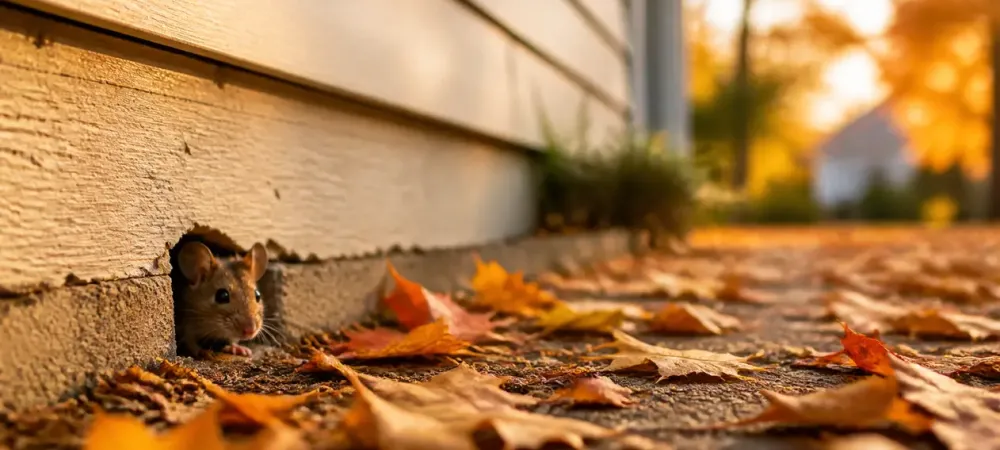
Mice move indoors every fall in Berkeley County because dropping temperatures and the county's mix of active farmland and new subdivisions push them toward the nearest warm structure, which is often a home. As fields get harvested and outdoor cover disappears, mice lose the food and shelter they relied on all summer and start looking for somewhere new.
Berkeley County's rapid growth adds to the pressure. The county grew from 122,073 residents in 2020 to an estimated 139,522 by 2025, according to e-WV: The West Virginia Encyclopedia, with new subdivisions built directly against farmland and wooded lots around Martinsburg, Inwood, and Falling Waters. That border between cleared farmland and new construction is exactly where displaced mice end up first.
The Peppermint Oil Myth
Peppermint oil does not reliably keep mice out of a home, despite its popularity as a natural remedy. Mice may avoid the smell for a few hours or days, but the scent fades quickly, and once it does, the opening it was supposed to guard is still wide open.
Sealing works for a different reason than smell. It removes the physical gap a mouse uses to get inside in the first place, so there's nothing left to avoid or get used to. That's the difference between a temporary deterrent and an actual fix.
How to Find and Seal Mouse Entry Points This Fall
Finding and sealing mouse entry points starts with walking the exterior foundation and checking anywhere a gap could be as small as a pencil's width, since that's all a mouse needs to get through.
- Walk the foundation perimeter. Check anywhere pipes, wires, or vents pass through the exterior wall.
- Check the sill plate. This is the seam where house framing meets the foundation, and it's a common gap point as a home settles over time.
- Inspect door sweeps and garage door seals. Daylight visible under a door usually means a gap large enough for a mouse.
- Seal confirmed gaps with the right material for the size and location. See the comparison below before grabbing whatever's in the garage.
Sealing entry points also reduces exposure to hantavirus, a rare but serious illness carried by wild rodents including deer mice. The West Virginia Office of Epidemiology and Prevention Services lists sealing openings as one of the state's recommended precautions against the disease.
Sealing Materials That Work vs. Don't
| Material | Works for Mice? | Why |
|---|---|---|
| Steel wool + caulk | Yes | Mice can't chew through steel wool, and the caulk holds it in place so it doesn't work loose. |
| Copper mesh | Yes | Resists chewing like steel wool, and doesn't rust in damp crawl spaces or foundation gaps. |
| Expanding foam alone | No | Mice can chew through cured foam once it hardens, so it only buys a little time. |
| Cloth, cardboard, plastic | No | Soft materials get chewed through quickly and are often reused as nesting material. |
| Dryer sheets or peppermint oil | No | The scent fades within days and never actually closes the opening. |
What to Do If Mice Are Already Inside
If mice are already inside, sealing entry points alone won't remove them, since exclusion stops new mice from getting in but doesn't clear an existing population. Check for fresh droppings, gnaw marks, or a musky odor near baseboards and cabinets before sealing everything up, since trapping active mice inside the walls creates a bigger problem than the one you started with.
If those signs are present, trapping or professional treatment needs to happen alongside exclusion, not instead of it. Petti Pest Control can confirm whether a property has an active population before recommending next steps, rather than guessing from the outside.
Frequently Asked Questions
Does peppermint oil keep mice away?
No. Mice may avoid the smell for a short time, but the scent fades within days and doesn't close off the opening they used to get inside. Sealing the actual gap is what stops them, not the scent around it.
What size gap can a mouse fit through?
A mouse can squeeze through an opening about a quarter inch wide, roughly the width of a pencil. Any gap that size or larger around pipes, vents, or the foundation should be sealed before fall.
Is it safe to clean up mouse droppings myself?
Yes, with precautions. The West Virginia Office of Epidemiology and Prevention Services recommends avoiding dry-sweeping droppings, since disturbing them can release particles into the air, and using wet-cleaning methods along with gloves instead.
Why do mice move into homes in Berkeley County specifically in fall?
Berkeley County's mix of active farmland and rapidly expanding new subdivisions puts a lot of new construction directly against the fields mice already live in. When those fields are harvested and temperatures drop each fall, mice move toward the nearest structure, which is often a home built at that farmland edge.
Seeing Signs of Mice This Fall?
Get your home's entry points checked before the fall migration picks up, or ask us about an active problem.
Call 304-263-9997