
Why Stink Bugs Target Orchards
In This Guide
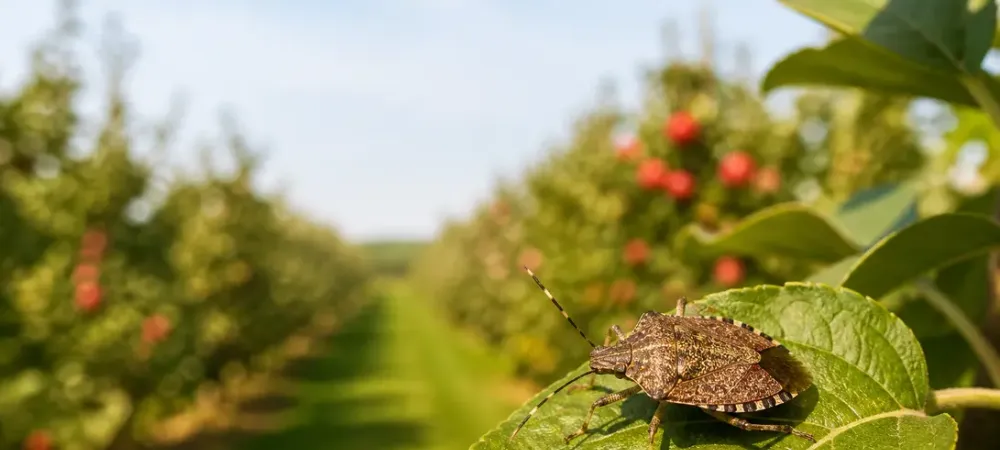
Why Stink Bugs Target Charles Town's Orchards
The brown marmorated stink bug feeds on a wide range of fruits and farm crops, and according to WVU Extension, it was first detected in West Virginia in 2004 and has since caused significant crop losses for farmers across the state. Jefferson County sits in West Virginia's Eastern Panhandle, the heart of the state's fruit-growing region, which means Charles Town's orchards see the same seasonal stink bug pressure that has made this insect a serious agricultural concern statewide.
WVU Extension reports that feeding damage causes blemishes and deformations that make fruit unmarketable as a fresh product, and that farmers whose crops have been hit have experienced significant losses. An orchard-dense area like Jefferson County gives the insect exactly the kind of concentrated food source it thrives on for most of the growing season, before populations shift toward homes in the fall.
What Actually Happens When They Move Indoors
Myth vs. Fact
Myth: Stink bugs that get inside a house will damage the structure or multiply over the winter.
Fact: According to WVU Extension, brown marmorated stink bugs do not cause any significant structural or cosmetic damage indoors, and they will not reproduce inside a home. They're a nuisance, not a threat to the building itself.
That doesn't make an indoor invasion pleasant. Large numbers can trigger alarm just by flying around a room, and crushing one releases the strong odor the insect is named for, but the underlying fear that they're breeding in the walls or eating through anything structural isn't supported by the entomology.
Stink Bugs vs. Asian Lady Beetles
Stink bugs and multicolored Asian lady beetles get lumped together constantly because WVU Extension notes they show the same fall behavior, both are drawn to the outside of houses on warm fall days, especially right after the first frost, looking for a place to overwinter.
| Trait | Brown Marmorated Stink Bug | Multicolored Asian Lady Beetle |
|---|---|---|
| Shape | Shield-shaped, about 3/4 inch long | Round, dome-shaped, about 1/4 inch long |
| Coloring | Mottled brown with white-banded antennae | Orange to red with black spots |
| Defense when disturbed | Releases a strong odor | Releases a yellowish fluid with a faint odor |
| Fall behavior | Clusters on sunny exterior walls before entering | Clusters on sunny exterior walls before entering |
How They Get In
Stink bugs look for any entry point they can find, and WVU Extension identifies cracks as small as 1/16 to 1/8 inch around windows, doors, eaves, overhangs, and dryer vents as common access points. Caulking window and door frames with a silicone or silicone-latex caulk, replacing damaged screens, adding weather stripping, and removing window air conditioners after summer use all close off the gaps stink bugs rely on.
What to Do Once They're Inside
Vacuuming stink bugs or knocking them into a bucket of soapy water are the methods WVU Extension recommends once they've already gotten in, using a handheld or bagless vacuum that can be emptied out each time. Indoor insecticide isn't recommended, since the insects can retreat into cracks and crevices to avoid it, and the chemical itself can pose a risk to people and pets in an occupied home.
A pest control treatment from Petti Pest Control applied outside before the fall migration starts is more effective than dealing with stink bugs after they've already found their way in.
Frequently Asked Questions
Do stink bugs damage a house once they're inside?
No. WVU Extension confirms that brown marmorated stink bugs do not cause significant structural or cosmetic damage indoors, and they will not reproduce inside a home. They're a nuisance rather than a structural threat.
Can stink bugs bite or sting?
No. Stink bugs don't bite or sting people. Their only defense is releasing a strong odor when they're disturbed or crushed.
Should I use insecticide on stink bugs I find inside?
WVU Extension doesn't recommend it. Stink bugs can retreat into cracks and crevices to avoid indoor insecticide, and the chemical itself can be a risk to people and pets. Vacuuming or dropping them into soapy water works better once they're already inside.
Why does Jefferson County see so much stink bug pressure?
Jefferson County sits in West Virginia's Eastern Panhandle, the state's main fruit-growing region, which gives brown marmorated stink bugs a concentrated food source throughout the growing season before populations move toward homes in the fall.
Stink Bugs Showing Up Around Your Home?
Get exterior treatment scheduled before fall migration brings them looking for a way inside.
Call 304-725-9997