
Why Barns Attract Carpenter Bees More Than Houses
In This Article
Why Barns Attract Carpenter Bees More Than Houses
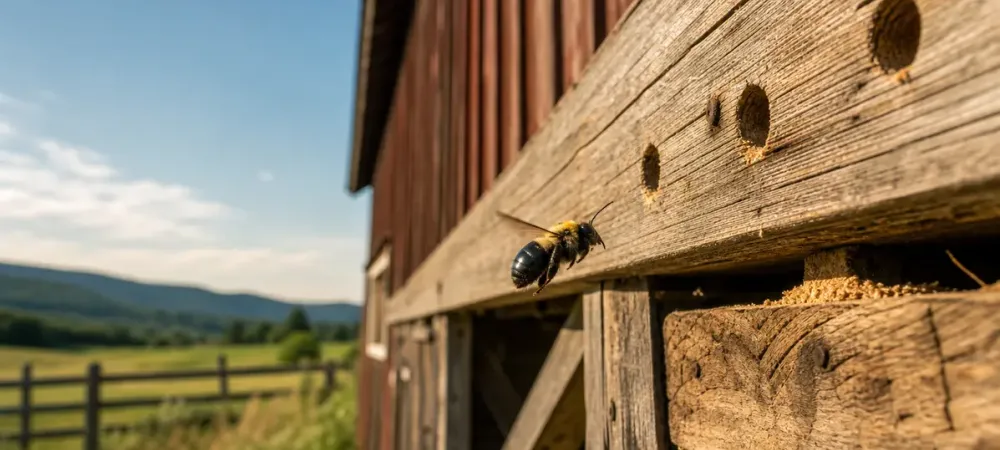
Barns attract carpenter bees more than houses because most barns are covered in large expanses of bare, unpainted wood, which is exactly what a female carpenter bee looks for when choosing a nesting spot. According to Virginia Cooperative Extension, carpenter bees nest in wood siding, log ends, and other areas of exposed bare wood, specifically calling out wooden storage sheds and small barns as common nesting sites.
Clarke County's older wooden barns compound the problem, since their siding, rafters, and trim often go decades without paint or stain, unlike a house that typically gets repainted on a regular cycle. A house with fresh paint on its trim gives a female carpenter bee far fewer entry points than a weathered barn with bare wood on every side.
The Aggressive Bee Myth
Male carpenter bees look aggressive but cannot sting, despite dive-bombing anyone who walks near the nest. Males patrol and defend the nesting area by flying at people, pets, and other insects that get close, but they have no stinger at all, so the display is entirely bluff.
Female carpenter bees do have a stinger and can technically sting, but they're generally docile and rarely do so unless directly handled or trapped against skin. The bee doing all the alarming behavior around a barn door is almost always the male that can't actually hurt anyone.
Carpenter Bees vs. Bumblebees
Carpenter bees and bumblebees get confused constantly, since both are large, heavy-bodied bees active around the same structures. The clearest difference comes down to the abdomen and where each one actually nests.
| Trait | Carpenter Bee | Bumblebee |
|---|---|---|
| Abdomen | Shiny, black, mostly hairless | Densely hairy, often striped |
| Nesting site | Bores round holes into bare wood | Nests in the ground or old rodent burrows |
| Social structure | Mostly solitary, occasional shared tunnels | Lives in colonies with a queen |
| Structural risk to a barn | Can bore repeated tunnels into exposed wood | None; doesn't nest in wood at all |
Why Wood Damage Gets Worse Over Winter
Carpenter bee damage often gets worse over winter because woodpeckers peck open the tunnels to reach the larvae developing inside, turning a small, round half-inch hole into a much larger, ragged one. A barn that had a handful of clean carpenter bee holes in the fall can end up with visibly torn-up trim boards by spring, even though no new bees have moved in.
What Actually Stops Carpenter Bees on a Barn
Painting or staining exposed wood is the most effective long-term deterrent, since carpenter bees strongly prefer bare, weathered wood over finished surfaces. Plugging existing holes without treating the surrounding wood tends to backfire, since females often just drill a new entrance a few inches away rather than relocate entirely.
Timing matters too. Carpenter bees start excavating new tunnels in spring, so a stinging insect treatment from Petti Pest Control ahead of that window addresses active bees and existing tunnels before a barn's trim boards take another season of damage.
Frequently Asked Questions
Do carpenter bees sting?
Male carpenter bees cannot sting at all, despite being the ones that dive-bomb people near a nest. Females have a stinger but are docile and rarely sting unless directly handled.
Can carpenter bees cause structural damage to a barn?
A single tunnel rarely causes structural damage, but the same holes get reused and expanded year after year, and woodpeckers often enlarge them further while hunting for larvae. Left untreated over several seasons, repeated tunneling in the same trim boards or siding can weaken the wood.
Does painting wood really stop carpenter bees?
Yes. Carpenter bees strongly prefer bare, unpainted wood, so painted or stained surfaces are far less attractive to females looking for a nesting spot compared to weathered, exposed wood.
Why do carpenter bees come back to the same barn every year?
Existing tunnels are often reused and extended by new females rather than abandoned, and unpainted wood that attracted bees once tends to keep attracting them unless the surface is treated or finished.
Carpenter Bees Boring Into Your Barn?
Get active tunnels treated before spring nesting starts, and ask about protecting exposed trim long-term.
Call 540-955-9997